Why Customer Advocates Are a Growth Strategy
Sales leaders can unlock faster, higher-quality pipeline by turning trusted client relationships into repeat business, referrals, and new-account growth.

Where it accelerates margin, how to make the right decisions, and why AI is reshaping the future of “build vs. buy.”
In this guest post, healthcare growth consultant Julie Walker shares a practical view of revenue cycle outsourcing as a performance lever rather than a last resort. She outlines what to outsource first, how to evaluate partners, and where AI improves accuracy, reduces denials, and accelerates cash flow. Read “About the Author” at the end of the blog to learn more about Julie. Enjoy (and thanks, Julie!)! The MarketLauncher Team.
For years, health systems treated outsourcing as a last-resort solution, something to pursue only when internal staff were overwhelmed or backlogs became unmanageable. Today’s operating environment has changed so dramatically that the old “do everything in-house” model is no longer economically or operationally viable.
Margin pressure, labor scarcity, payer complexity, and rising denial rates have forced executives to revisit a fundamental question:
The truth is that outsourcing, when executed strategically, is no longer a cost-cutting tactic. It is an operational force multiplier.
Just as importantly, outsourcing can create tighter feedback loops, turning day-to-day execution into market intelligence that helps leaders refine processes, technology, and decision-making more quickly.
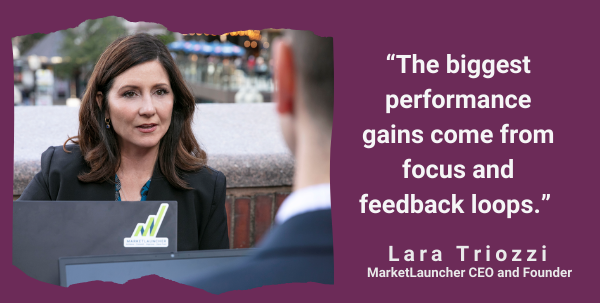
Consider this quote from Lara Triozzi, CEO and Founder of MarketLauncher.
“The biggest performance gains come from focus and feedback loops. I think this is true for any outsourced business process. For example, when lead generation is outsourced to a team that’s fully dedicated to that function, it creates consistency, faster iteration, and better visibility into what’s resonating in the market. That intelligence gets back to cross-operational teams faster, which improves everything downstream, from messaging to conversion.”
While Lara speaks from a go-to-market lens, the same principle applies to revenue-cycle outsourcing: dedicated teams drive consistency, faster iteration, and clearer performance visibility.
This shift is already well underway. According to Becker’s Hospital Review, more than 77 percent of health system finance leaders now use some form of revenue-cycle outsourcing, with the majority reporting satisfaction with those partnerships.
Below, we discuss how:
Not all revenue-cycle functions are created equal. Some require institutional knowledge and patient-facing nuance. Others are high-volume, rules-based, and ideal for specialized partners with scale, sophistication, and advanced technology.
These functions are prime candidates for outsourcing because vendors can operate them more efficiently than internal teams.
Outsourced coding teams maintain certification, quality assurance, and continuous education at a level most health systems struggle to sustain internally. Just as importantly, they flex capacity up or down as volumes change, eliminating chronic understaffing or overstaffing.
Industry research aligned with the Healthcare Financial Management Association (HFMA) shows that organizations that outsource targeted revenue-cycle functions can improve collections by up to 15 percent, driven by greater accuracy and faster downstream claim processing.
Large outsourcing firms manage millions of encounters and develop payer-specific intelligence that internal teams rarely match. This scale directly improves yield, accelerates cash flow, and increases net revenue.
Black Book Market Research reports that organizations leveraging outsourced RCM services often operate with 15–20 percent lower administrative costs than fully in-house models due to scale efficiencies and embedded automation.
Denials have become too complex and payer-specific for most health systems to manage effectively on their own. Outsourced teams bring specialized expertise, root-cause analytics, and standardized workflows that reduce preventable denials and accelerate overturn rates.
As denial complexity increases, nearly 40 percent of U.S. hospitals now outsource complex claims and advanced revenue-cycle functions, an acknowledgment that specialization outperforms internal models in these areas.
Partners with scale typically deliver:
From a CFO perspective, the margin impact is tangible. Many organizations see a 2- to 5-times return on investment, driven not by labor arbitrage but by yield improvement, cycle-time reduction, and fewer preventable denials.
Revenue-cycle leadership turnover is high, and training curves are long. Outsourcing mitigates three persistent risks:
As labor volatility continues, MGMA data suggests that more than one-third of providers plan to outsource or automate portions of the revenue cycle by 2025 to stabilize operations and reduce dependency on scarce internal talent.
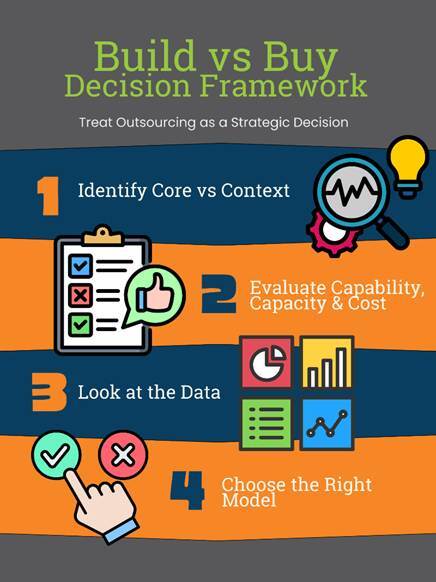
Organizations that realize the greatest value from outsourcing treat it as a strategic design decision, not a reaction to staffing shortages or operational pain.
Below is a practical framework to guide executive teams.
Ask: Does this function meaningfully differentiate our patient or provider experience?
If not, it is likely a candidate for outsourcing.
Functions typically retained internally include:
Functions commonly outsourced include:
Three questions determine readiness:
If the answer is “no” to any of the three, outsourcing becomes a strategic lever worth pulling.
Strong outsourcing decisions are grounded in data, including:
If these metrics cannot be reliably benchmarked internally, a partner can often do so.
There are three primary outsourcing models:
Many large health systems benefit most from hybrid models where internal teams retain oversight while vendors drive execution, analytics, and continuous improvement.
The next evolution of outsourcing is not offshoring or labor substitution. It is AI-enabled operating models where vendors apply machine learning across large datasets, insights improve continuously, and performance guarantees strengthen over time.
The more encounters a partner touches, the smarter its models become—particularly in:
This level of intelligence requires scale and investment that most health systems cannot replicate independently.
The future state is not replacing staff with AI, but AI augmenting human expertise to increase throughput and accuracy.
Outsourcing partners with embedded AI consistently deliver:
This combination creates a durable margin advantage.
Many provider organizations struggle to operationalize AI due to fragmented data, limited IT capacity, competing capital priorities, and difficulty attracting advanced analytics talent.
Outsourcing firms overcome these barriers because AI is a core investment, not a competing initiative.
The emerging formula is clear:
Health-system oversight + Vendor scale + AI-enabled execution
= Stronger performance, lower cost, and more predictable margin improvement
Large health systems can no longer afford to operate as full-service revenue-cycle organizations. The economics, labor market, and technology landscape no longer support that model.
Outsourcing has evolved into:
When executed thoughtfully with strong governance and the right partner mix, outsourcing becomes a competitive advantage, not a concession.
Sources:
Becker’s Hospital Review • Healthcare Financial Management Association (HFMA) • Black Book Market Research • Medical Group Management Association (MGMA)
Frequently Asked Questions about Revenue-Cycle Outsourcing
1) What is revenue-cycle outsourcing (RCM outsourcing)?
Revenue-cycle outsourcing is when a healthcare organization partners with a third party to perform specific revenue-cycle functions such as coding, A/R follow-up, denials, or eligibility under defined workflows and service levels.
2) What revenue-cycle functions are best to outsource first?
High-volume, rules-based functions are often best to outsource first, such as coding, A/R follow-up, underpayment recovery, eligibility verification, and denials management.
3) Which revenue-cycle functions should typically stay in-house?
Functions closely tied to patient experience, payer strategy, and governance, such as patient financial experience oversight, contracting strategy, revenue integrity leadership, and quality governance, are often retained internally.
4) What’s the difference between staff augmentation, co-sourcing, and fully outsourced RCM?
Staff augmentation fills capacity gaps with external staff; co-sourcing shares accountability between internal and vendor teams; fully outsourced models shift execution to the partner with the greatest performance lift potential.
5) How do you decide “build vs. buy” for a revenue-cycle function?
A practical test is capability, capacity, and cost. If you lack best-in-class expertise, can’t sustain staffing/QA, or can’t match unit economics and automation of a scaled partner, buying becomes a strategic lever.
6) What KPIs should be included in an RCM outsourcing scorecard?
Common KPIs include days in A/R, denial rate and overturn rate, coding accuracy, DNFB, cost-to-collect (or cost per claim/encounter), net collection rate, and productivity/throughput measures.
7) How quickly can outsourcing improve margin or cash flow?
Time-to-impact varies by function, baseline performance, and integration readiness, but organizations typically look for measurable cycle-time and yield improvements once workflows, governance, and SLAs are stabilized.
8) What are the biggest risks of revenue-cycle outsourcing?
Common risks include weak governance, unclear ownership, poor data quality, misaligned incentives, and inconsistent quality controls. These are mitigated with SLAs, performance guarantees, structured escalation paths, and routine business reviews.
9) How does AI change the economics of outsourcing in revenue cycle?
AI can improve accuracy and speed across claims workflows (e.g., denial prevention, underpayment detection, eligibility automation, coding assist). At scale, models improve over time as more encounters are processed.
10) What should be in an RCM outsourcing contract or SLA?
An effective SLA typically defines scope, quality standards, turnaround times, performance metrics, reporting cadence, security/compliance requirements, and remedies or performance guarantees where appropriate.
11) How do we ensure patient data privacy and compliance with an outsourcing partner?
Use a strong BAA (where applicable), enforce least-privilege access, require audit trails, confirm security certifications and incident response protocols, and include clear compliance responsibilities in the contract.
12) What’s the most common reason outsourcing partnerships fail?
The most common failure mode is governance when roles, decisions, metrics, and escalation paths aren’t defined and enforced consistently across internal teams and the partner.